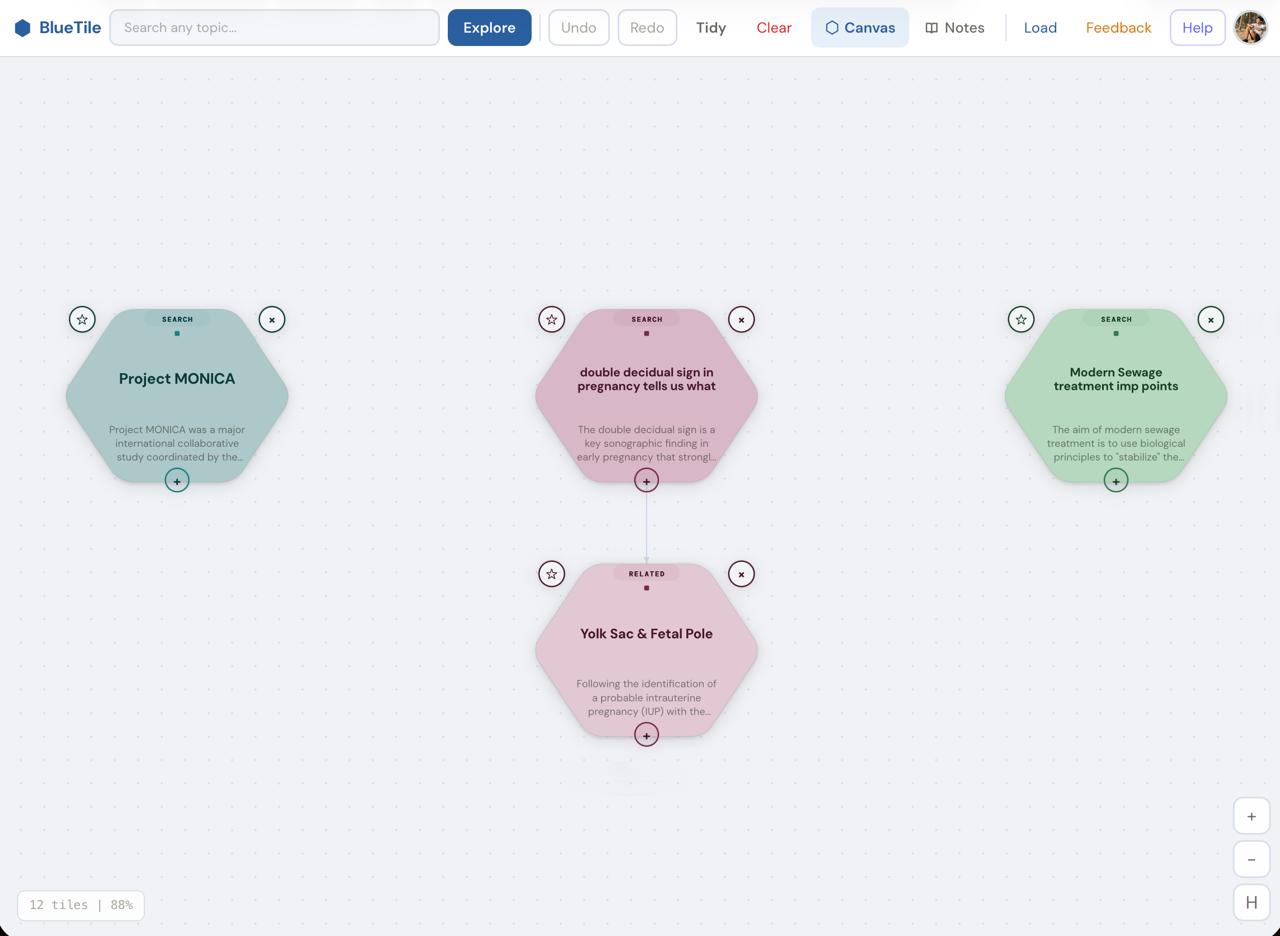
Watch your notebook build itself.
A real session — search a topic, follow the connections it suggests, and watch each tile file itself into your 20th notebook by subject.
Your 20th notebook, the way you'd build it — except it builds itself.
Categorizing 19 subjects by hand is impossible. Maintaining it across 4 years is harder. BlueTile does both — every concept you explore lands in your 20th notebook, organized by subject, automatically.
- Highlight any line, formula or symptom — there forever, ready when you skim.
- Add your own notes — your mnemonics, your professor's tip, the way you remember it.
- Star important topics for one-tap revision.
- Subject-organized automatically across all 19 NEET PG subjects.
- Search across everything you've ever studied — instant recall, never lost.
Three things happen, every time you study.
Explore
Type any topic — a tile generates with a summary, citations, and four related directions to follow.
Tile lands
Each tile is synthesized from standard medical textbooks (Harrison's, Robbins, KD Tripathi…) — cited, never fabricated.
Filed by subject
Auto-organized in your 20th notebook across all 19 NEET PG subjects. Highlight, comment, star, search — anytime.
Three habits that make a textbook your textbook.
Three things you can do on every BlueTile concept that flashcards and PDFs can't.
Highlight what matters.
Anything you read, marked the way you'd mark a textbook with a pen. Yours, forever.
Add your own notes.
Your professor's tip, your mnemonic, the way you remember it. Add it to the tile and it lives there.
Star and search.
Mark what you'll revise. Search across your entire library, instantly. Find anything you've ever studied.
A study tool with real depth.
Past the tiles and connections, BlueTile gives you a full place to read, question, and make every concept your own.
A real reading room
Everything you've studied, in one place. Search across your whole library, filter to recent or starred, and jump back to any topic — in a map or a clean study sheet.
Ask anything, not just the suggestions
Got a doubt the tile didn't cover? Type your own question on any topic and it spawns its own cited tile — your curiosity, answered and filed.
Drop in your own diagrams
Paste or crop an image straight into a tile — a flowchart, a slide, a hand-drawn pathway. It lives in your notes, right where you need it.
Side-by-side tables, on demand
The comparisons examiners love — UMN vs LMN, exudate vs transudate — generated as clean tables inside the tile, so the distinctions stick.
Why a 20th notebook helps — and why your memory isn't to blame.
vs 38% — test scores when students studied related concepts mixed together vs. one topic at a time, one day later. A 20th notebook does exactly this — automatically.
Rohrer & Taylor, J. Educational Psychology (2014)
all agreeing — students using concept-map learning consistently outperformed peers studying traditionally, by a large margin. A 20th notebook is a concept map.
Schroeder et al., Educational Psychology Review (2024) — meta-analysis
standard medical textbooks — Harrison's, Robbins, Parson's, KD Tripathi and more — synthesized into every page of your 20th notebook. Cited, not fabricated.
BlueTile sources
BlueTile works with the tools you already love.
Flash cards drill you for active recall. Video lectures walk you through the curriculum. Textbooks give you the source. BlueTile adds the layer that ties everything together — and gives you a 20th notebook to come back to.
Use BlueTile alongside everything else. It's the layer that ties what you've already studied into a 20th notebook you'll actually come back to.
Built with the people who'll use it.
Honestly I just wanted somewhere to dump what I'd already studied so I'd actually find it again. Came back two months later for revision and my MUDPILES note was sitting right under Anion Gap, exactly where I'd left it.
Was reading about beta blockers for pharma and it linked straight to the MI pathophys side. Never get that from notes — I'd have it in two different notebooks and forget the connection. That bit sold me.
Doesn't replace anything for me — still watch lectures, still do qbanks. But the random doubts I get during a lecture? Those go in here, and it's the only thing I actually re-read before exams.
Free while we're in beta — for the first 100 students.
BlueTile is in testing, and we're learning what actually helps your prep. The first 100 students get full founding access, free. After that, new students join the waitlist — and BlueTile becomes a paid product from there. Founding students keep a permanent discount for getting in early.
No credit card. No catch. Just get in before the 100 spots are gone.
- Unlimited exploration while we're in beta
- Your full Personal Textbook — highlight, note, star, search
- Cross-subject bridges on every topic
- Textbook-cited answers, never fabricated
- Comparison tables and diagrams inside any tile
- Saved maps that sync across your devices
Spots are limited to 100. Once we're full, new students join the waitlist. Join the waitlist →
Every account includes: textbook grounding · cross-topic bridges · cited textbook references
Join the waitlist
Founding access is free for the first 100 students, and spots are going fast. Once they're gone, BlueTile goes paid — drop your email to hold your place in line and tell us what would make it useful for your prep.